Can optimism ever be bad?

comments 3
Growth

“Self-Portrait. Between the Clock and the Bed” by Edvard Munch. Needless to say, the symbolism here is quite pessimistic, given his apparent age and positioning.

Our psychology

Taking a first step into management from an individual contributor background can be tough. Not only is the role a step up in terms of accountability and responsibility, it also widens the interfaces in which one operates: increased debate and discussion, more exposure to opposing views both inside and outside of the team, and deeper emotional connections, tensions and breakthroughs.

An engineering manager can find themselves as a conduit and chair for all sorts of situations: debates about scope and priority with Product, dealing with clashes of ideals about which framework should be used for a new application, through to fallout in the team after missing a deadline, ongoing performance issues, and believe me, I could go on.

In addition to continuing to utilize your technical strength, you also need to also develop a strong mindset that can identify and work with the psychology of those on your team. Having worked with a great number of people over the years, I have seen that conflict can manifest in so many ways beyond the prescribed roles that people work in.

Yes, of course, there is a natural tension between Commercial, Product, and Engineering. But even those with the same skillset can find themselves clashing with each other due to the psychologies that frame the way that they think about the world.

Let’s look at the play between pessimism, optimism, realism and idealism. We face this more than we might think; both within ourselves and in the disposition of others that we work with. How does it manifest and what can we do about it to help our teams succeed?

The outlook matrix

Now, before I go any further, I must admit that the matrix I am about to present to you is not my original work. I stumbled across it on a quiz website aimed at what I can only assume to be schoolchildren, given that some of the questions were asking my reaction to someone telling me that my crush likes me, or whether the teacher has yelled at me for being late to class. Sometimes inspiration comes from the strangest places. Don’t worry, though: the actual origin of the image differs.

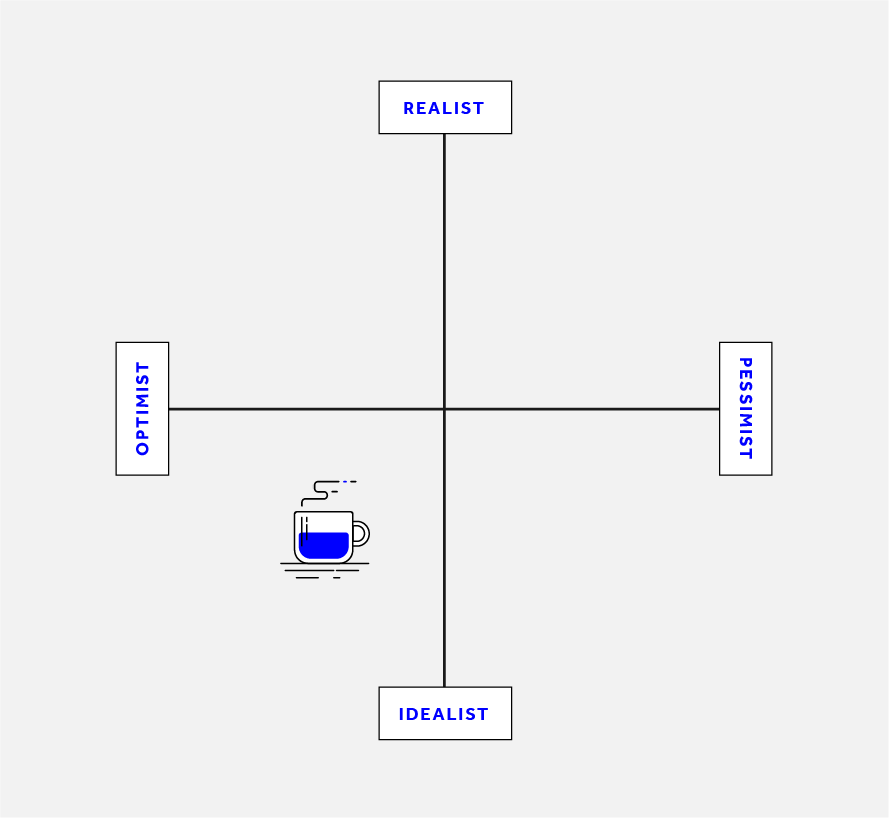
But anyway, to the matrix. It represents the tension between optimism and pessimism contrasted with the tension between idealism and realism.

Thanks to @eleventhleft for recreating this image for me. I’ve marked my default position with the coffee cup.

Both you and your team will naturally gravitate to a default position on this matrix: our natural mindset. Yet, that default is not fixed. Often we will find ourselves temporarily at other positions on the matrix in reaction to particular situations. When faced with the planning stage of a project we may inhabit a mindset of optimism and idealism, inspired by the CEO’s vision of how the feature is going to completely revolutionize the application. During the tail end of a death march project we may find ourselves channelling a combination of pessimism and realism.

Let’s explore the nuances of the two axes with respect to managing software teams. We’ll discover that the extremes of the psychologies can actually drive both positive and negative behavior. There is no perfect place to be for all situations.

Optimism and pessimism

Some basic terminology that you’ll already know: optimism is the general tendency to expect positive outcomes, and pessimism is the general tendency to expect negative outcomes. Initial categorization of these traits could lead to thoughts that optimism is entirely beneficial and that pessimism should be entirely avoided. There is some truth in this, however there are subtleties between optimism and pessimism and two related traits – credulity and skepticism – that are important to understand and separate.

Pessimism, of course, can drive a lot of negative behaviors. A pessimist can shut down conversation and throw water on to the fire of a great idea before it is fully formed. A pessimistic team can sap the creativity from a product owner and lead to an aversion to try anything innovative and challenging. Pessimism can make estimating work a nightmare: you just wish you could change the team’s mind, but their psychology is defeating you.

Yet, it is important to recognize that pessimism is related to, but quite different from, skepticism. Whilst a pessimist will naysay ideas due to their mindset, a skeptic will apply questioning to the idea to ensure that it is as fully formed and correct as it can be. Pessimism comes from the wrong place, but skepticism comes from the right place. Don’t get them mixed up, as a healthy skeptic can inject more rigor into your ideas and improve them as a result. Skepticism should be thoroughly encouraged and praised. It is essential for critical thinking.

Conversely, optimism can in many situations be extremely useful: a person with an optimistic outlook on life can drive many positive behaviors in themselves and others. An optimistic manager, especially in times of high stress and difficulty, can be a calming and balancing influence.

Optimism should be commended, but it is not to be confused with credulity, which is the tendency to be too ready to believe that something is real or true, without sufficient evidence. A credulous leader can make irreversible decisions based on false premises. A credulous team can make a poor technology framework choice without properly evaluating it. That same credulous team can underestimate the length of time it takes to complete a project and overpromise and repeatedly miss deadlines.

Drive towards optimism but watch out for credulity. Equally, reward and encourage skepticism, but don’t confuse it with pessimism. The subtleties are critical.

Idealism and realism

Idealists believe that reality is constructed from ideas: that reality is itself a mentally constructed concept. Realists believe they see the world objectively as it is. Without straying into the realm of early Greek philosophy, we can place idealism and realism at two ends of the vertical axis in our diagram.

Idealism and realism can both drive positive and negative behaviors. Both have their place and time. Idealism within a founder or leader can drive everybody towards a vision of the future, no matter how challenging it is to get there. Think of Steve Jobs and his reality distortion field.

Idealism can drive innovation; it can rally a team behind a cause much greater than themselves. However, idealism can also create issues – it can become radicalism. It can create standards that may be entirely unachievable. Radicalism can cause heated arguments over pull requests. It can cause deadlocks in thinking and endless arguments. Idealism should serve as a guide, but the path towards idealism can never be entirely pure: the fact that we are just humans and are trying to get stuff done to a deadline means that there will always be hacks, shortcuts and compromises. We must be pragmatic. A healthy pragmatism between idealism and realism means that things actually get done.

Too much realism, on the other hand, can have negative consequences. Extreme realists can judge idealists as uninformed, irrational or biased, which can kill innovation. Someone has to come up with that crazy moonshot after all. Extreme realism may prevent a department with a crumbling legacy technology stack from ever trying to modernize because it is seen as too difficult, which could ultimately be the death of that company.

Your team will likely have a combination of idealists and realists. Harness the vision of the idealists to see where the team should move towards, but use the realists to help create the steps needed to get to that destination. A pragmatic balance of idealism and realism creates an actionable plan that moves in the right direction over time.

A balancing act

We need optimism without credulity, skepticism without pessimism, and a balance of idealism and realism. Where do you naturally sit in the matrix? What about the individuals in your team? What about the team as a whole? Is the group dynamic different to the sum of the individuals? Why do you think that is?

Are you able to change your position to counter-balance extreme opinions within the team, even if that mindset is not the natural one in which you reside? Also, are you able to notice when your own default position can cause biases in your own judgement?

Personally, I tend towards optimism but I can recognize my pessimism which can be higher on days that I am stressed. I sometimes suffer from credulity when talking to someone very persuasive or senior. In these situations I tend to have to remind myself to apply more skepticism. I would like to think that I have a good balance between idealism and realism, but try asking me that when I’m in a pinch near a deadline!

How about you?

What does trust have to do with Israeli day care centers?

Leave a comment
Growth

Trust, two ways

You can fake it for a while
Bite your tongue and smile
Like every mother does her ugly child

But it starts to leaking out
Like spittle from a cloud
Amassed resentment pelting ounce and pound

— The Shins, Turn On Me

A core tenet of leadership is trust.

This trust goes both ways. Your staff need to trust in your ability as their leader to be hard-working, just and candid with them. Conversely, you need also to be able to have trust that your staff are able to do the same for you. High levels of trust create mutually beneficial relationships where each party wants to do their best for one another. Low levels of trust create dissidence, politics and a gradual collapse of teams.

The importance of trust goes beyond just how well you get on with those around you: it has a direct impact on your effectiveness and output as a manager. Aside from my immediate responsibilities in day-to-day activities, I would say that some of the most important facets of my role are attracting and retaining the best people I can find and, once I’ve hired them, ensuring that they are doing challenging and satisfying work so that they can accelerate their careers. How does trust factor into this?

Trust in your staff ensures that you’re able to delegate the work best suited to them so that it is both satisfying and stretches their ability so they can grow. Trust ensures that you’re neither micromanaging nor deserting them while they’re doing it. Trust means that your conversations can be candid and therefore tackle the tough but pressing issues. Trust means a small problem is discussed early and is resolved, rather than it silently snowballing until somebody hands in their notice.

The most challenging part of maintaining trust is that it is extremely fragile. A relationship and rapport that has taken years to build can be lost in an instant. One unfortunate event, intentional or not, can rewind a relationship significantly. Depending on the size of the mishap, it can even erode the default level of trust that others at the company have in you, regardless of whether you work closely with them or not, and there’s little you can do to take it back; that’s just human behavior.

But you’re getting paid well, right?

One viewpoint that I have observed, especially from those that are outside the technology industry, is that generous compensation – whether through raw salary, stock options, or other perks – has the effect of excusing untrustworthy behavior from leaders and the company as a whole. The argument is that if people are getting paid well for their efforts, then, surely, they can confide in their compensation when other dimensions of their role are more abrasive.

Well, I don’t agree. I like to think that, for those of us working in the knowledge industry, we are intrinsically motivated to do a good job and to improve our skills independently of the exact quantity of our renumeration. Many of the software engineers that I know, including myself, still enjoy programming enough to do it in our spare time for fun. In fact, the 2018 Stack Overflow Developer Survey cited that 80% of their respondents still do programming as a hobby. So yes, of course, we like to be paid as well as we can for what we do (who wouldn’t take a pay rise?), but the environment in which we perform our jobs, especially within the dynamics of the relationships that we have with our manager, direct reports and our peers, is a key foundation of job satisfaction.

For example, months of turmoil at Uber resulted in many employees quitting, despite the impressive growth of the company and high compensation. Indeed, we have all heard – probably from our parents – that money doesn’t buy happiness, but research has reinforced that viewpoint. A poll of over 1 million people showed that income level only correlates with happiness to a “satiation point” over which additional income is not associated with greater happiness. In the technology industry, which is generally well compensated, most people earn more than this satiation point, so other factors, such as relationships with colleagues and purpose and challenge of work, are the drivers for retention.

Other surveys have produced similar results. Stefan Sagmeister’s TED talk gave a highlight of another study in this area. Watch the clip until 3:26.

Getting happiness from your social interactions at work requires that they come from a place of mutual respect and trust. When they aren’t underpinned by those foundations, all sorts of things can go wrong. Let’s see how.

Breaking the contract

There is a case study which beautifully highlights the nature and fragility of trust. I was fortunate enough to see Clay Shirky speak at Brandwatch‘s NYK conference in Chicago. His talk brought to my attention a paper that showed proof of a contraction of the deterrence hypothesis. What does this mean? Well, the hypothesis is that introducing a penalty, such as a fine, for unwanted behavior, will reduce the occurrence of that behavior from happening in the future.

The paper performed a field study of a group of 10 day-care centers in Israel. When parents sign their child up to attend a day-care center, they sign a contract that states that it operates between 7:30AM and 4PM. This implies that parents should come and pick up their children at the end of the operating hours. If parents were to turn up late, they would notice that a teacher would also have to stay late until all of the children were picked up. The authors of the study note that before the study happened parents were only occasionally late and would rarely come any later than 4:30PM.

This relationship was based entirely on trust. Parents knew that if they were late to pick up their child then this would have a direct effect on the time that the teachers were able to go home. Nobody wants to feel guilty, right? But could lateness be prevented altogether? The deterrence hypothesis presumes that the introduction of a penalty – in this case a fine – for the parents of children that are picked up late, would reduce the occurrence of it happening.

So, that’s what the study did. After the 5th week of monitoring lateness they introduced a fine into 6 of the day-care centers. Any child that was picked up more than 10 minutes late would require the parents to pay the equivalent of roughly the hourly rate for a baby-sitter. After 17 weeks, they removed the fine and explained to parents that it was a trial that they were evaluating. What were the results?

Surprisingly, the introduction of the fine made the late behavior worse! You can see the dramatic increase in late arrivals from the group with fines in week 6. Prior to the fine being introduced, a late pick-up would mean a feeling of guilt from the parents when they saw the teacher waiting there with their child upon arrival. The deterrent against lateness was one of mutual understanding that lateness causes inconvenience for another human.

After the introduction of the fine, however, a relationship built on trust and respect became one that was contractual and based on money. Parents who didn’t want to rush to the day-care center at the end of the day could instead just pay a small amount of money to vindicate themselves from any bad feelings.

Even more surprising was the observation that on week 17, after the removal of the fine for late pick-up, the behavior didn’t revert back to the pattern before week 6. A relationship based on trust, after transformation into one dictated by money, stays broken.

What can we learn from this? Firstly, we can see that you can’t excuse poor relationships or untrustworthy culture by throwing money at the problem. Additionally, once you’ve gone past the breaking point for trustworthy relationships, they’re extremely challenging to restore.

How do we build and maintain trust?

Building trust requires no special techniques or skills that aren’t available to you in this moment. In fact, when trying to increase rapport through means that feel forced or unnatural, you’ll find that it has quite the opposite effect. Trust is built through being open and consistent with your intentions and actions, and is reinforced by acting on behalf of the values that you hold true.

Here’s some primers for your thoughts on how to build and maintain trust.

  • Getting relationships off on the right foot. If you are taking on a new member of staff then beginning that relationship with the opportunity to explicitly talk about how each of you likes to work is a good move. I have previously written about a contracting exercise that serves this purpose. Give it a go.
  • Being transparent and true to yourself. When I am driving, I find unpredictable drivers who move suddenly much more dangerous than those that are going too fast. You want to ensure that others find your actions and reactions as predictable as possible. If you find that you have to act out a particular persona for work when in fact you are quite different outside of the office, then, with time, this is only going to work against you. If you can’t be transparent and honest with yourself, how can you be transparent with others?
  • Being candid. Candor is your tool for showing that you care. Praise when praise is due. Critique openly when necessary. Nobody likes to hear honest feedback when that feedback isn’t positive, but, with time and practice, your directness will be respected and trusted. People will gravitate to you because you have nothing to hide.
  • Having time for your staff. Absentee leaders, especially those with unpredictable commitments and demonstrable flakiness, send a bad message. Being a trusted leader requires being present. If you can’t be there physically, then you can be there via video call. If you can’t be there via video call, then you can be there via email and messages. Just be there.
  • Making your intentions clear. If you have to deliver some unpopular news, then you should be clear on your intentions when doing it. Frame bad or unpopular news with the reasoning behind the decision that you have had to make. Like doing mathematics at school, show your workings. Demonstrating that a decision was difficult allows others to understand and be empathetic towards your situation, even if it has a negative outcome from them. After all, you would never act in malice. There is always a reason.
  • Admitting your own conflicts of values. Since leaders are meant to represent the values of the organization as well as their own values, there are sometimes conflicts. For example, the senior leadership may have made a decision that you disagree with but you have to carry out regardless. In these situations, the path to maintain trust with your staff involves admitting those conflicts of values. You can still see a decision through whilst disagreeing with it and letting others know that is the case. You can disagree and commit.

In summary

Trust takes a long time to build and retaining it requires transparent and consistent effort to maintain. It can be lost surprisingly quickly. We can’t replace trust with a contractual obligation or financial contract. Being yourself and acting in congruence with your own values gets you a lot of the way. Admitting your own struggles and conflicts makes up the rest of the journey.