How do I progress to the next level in my career?

comment 1
Q&A

Let’s move on to another question that I get asked frequently.

Q: How do I progress to the next level in my career?

This is a broad question, and every single person is different. However, this question is interesting because it can be used to begin some valuable self-inquiry.

What we’ll do is:

  • Explore what careers may look like and what motivates us. These topics are well worth revisiting when you feel like you are getting frustrated or stuck, or are wondering what the future may hold for you. 
  • Think about some practical ways in which you begin to take your progression into your own hands. Once you know what you’re after, how do you get there?

Let’s get going.

The short answer

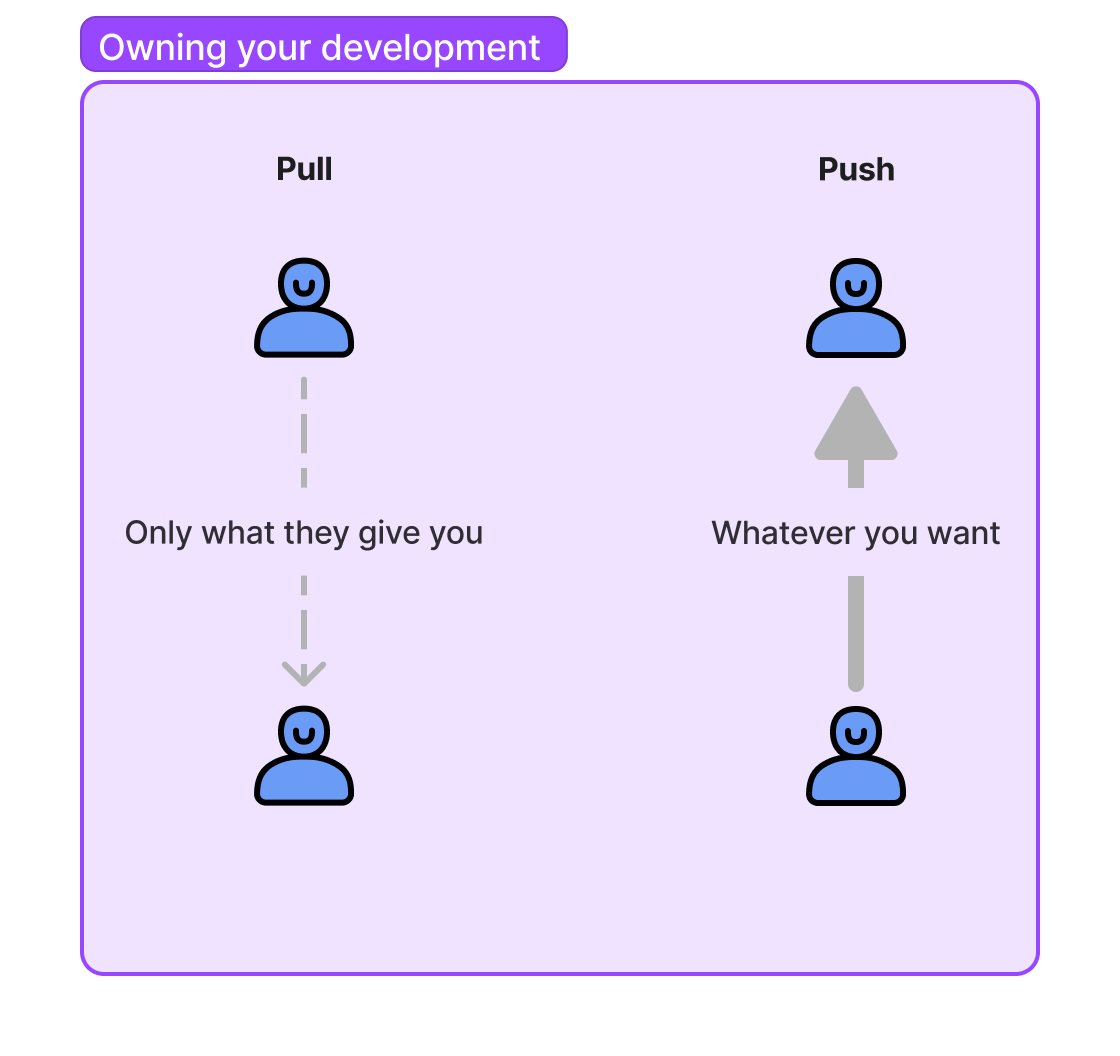
Before we go any further, there is one important axiom that is true about your career, regardless of your experience or role: it’s your responsibility, and you need to take full ownership of it.

Yes, it may be true that you work at a company that provides career tracks. But it’s your responsibility that you actually know what you are after, and that you are intentionally making progress in that direction. 

Frameworks like career tracks act like sat nav systems: they help route your vehicle to the destination, but you are required to enter the destination and actually do the driving.

Sitting back and assuming that the progression will take care of itself with tenure rarely yields the same result as actively taking strong ownership. This is because a clear intention aligns your own mind—consciously and subconsciously—and that of your manager and peers who are in turn able to assist you in finding opportunities for you.

So you need to take responsibility in getting to where you want to go. But that leads to another important question.

What do you actually want?

This is where the introspection begins. When we consider our careers, we can fall foul to shallow thinking about what will make us fulfilled versus what we truly want, free of assumptions, projections, and bias.

For example, we may imagine our career will be a linear progression where we travel up and to the right gaining experience, new job titles and increased remuneration along the way. 

However, the reality is that it is very hard to predict the future. Up and to the right is an illusion.

For example, take my own story. When I was doing a Ph.D., I was one hundred percent sure I was going to be an academic, working towards my dream of becoming a professor. But postdoctoral positions were limited when I graduated and I was only able to make the shortlist for the positions I wanted. A pressing issue was that I needed money—I had rent to pay—so I joined a local startup as an engineer instead.

As I continued to hone my craft at building software, I got interested in managing people and leading teams. Whilst preparing myself by reading books and articles, the company raised a significant amount of investment and grew quickly. This preparedness gave me the opportunity to lead a team, and over time, I progressed into senior management as VP Engineering.

Did I think I wanted to take that path ten years ago? Nope, I didn’t even know it was possible. And it’s likely that you’re going to be unable to predict what’s possible for you in the same timeframe.

Think about it: if you are in the early stages of your career, the young founder you may end up working for in twenty years may only have just been born. Imagine that!

What careers really look like is a bit like a squiggle, rather than a ladder.

It’s natural that as you grow and evolve as a human being, your preferences for your work grow and evolve concurrently. We progress through different stages of our lives, seeking different challenges, interests, domains and balances between our time, money and willingness to expose ourselves to risk and stress. 

Our changing preferences mean that our future selves may make choices that our present selves would find unappealing, which in turn means that it’s hard to guarantee that we’re making globally optimal choices that will serve us well later. Thus, on one hand, the squiggle represents our changing desires.

But the squiggle also represents factors that are outside our control. Throughout our careers we will face recessions, layoffs, bad timing, illness and changing family circumstances that will all have an input on where we are going. To balance the bad with the good, we may one day have an incredible idea for a business or meet our future co-founder. We may become passionate and skilled in something that hasn’t been invented yet. We may come into a lot of money via a company exit that gives us more freedom to choose how we spend our time.

In order to be happy with your career progression, you need to embrace that there will be unexpected possibilities and unpredictable change in the future. Turn your attention away from limiting criteria (i.e. aiming only for position X at company Y, or salary Z) and instead turn inwards to hone your craft and align your passion so that you are correctly placed and skilled for whatever may arise in future.

Turning inward

Be wary of playing myopic games. They can erode your long-term freedom.

Take money for example. We’d all be pleased if we earned more money. Who wouldn’t be? Money motivation is strongest at the beginning of our careers where we are trying to get our longer term financial futures in order by paying off our education and early life debt and saving for down payments on a home.

And certainly, if you are optimising towards your total compensation at all times, then the best thing you can probably do is to keep changing jobs. However, this isn’t a sole long term game that you can continually play—not just because it’s exhausting—since there are many other aspects that make your career and life rewarding that need your focus too.

I’ve always liked the model proposed by Dan Pink in Drive, which is that what truly motivates us is not the carrot-and-stick approach of ever more money, but instead the ability to craft our careers to give us the following three things:

  • Autonomy: the desire to be self-directed.
  • Mastery: the urge to continually hone our craft and increase our skills.
  • Purpose: the desire to do something that has meaning and is important to us.

One of the arguments he makes to support this is that our entire technology industry is supported by the voluntary efforts of extremely skilled people that are doing work for free and releasing it as open source software.

And of course, xkcd has a great take on it:

Very few of us can afford to work for nothing. But maybe a better way to understand how to progress in our careers is working out what we would fill our time with if money had nothing to do with it, and then work on honing our craft so that our passions can become profitable too. 

This approach has an important corollary—once you’re able to do what you’d probably do for free, you’ll likely progress even faster because you are genuinely passionate about it.

Focus on the craft and the opportunities and money will come. It’s a worthwhile long term game to play.

Once you know what you want, how do you get there?

The short answer at the beginning of this article stated that your career is your responsibility, and you need to take full ownership of the path that you are on. That’s true, but you’re unlikely to be able to make that journey on your own.

Progression inside any organisation is a team play that also includes your manager, your colleagues, peers, and whoever else is responsible for approving promotions. It’s not a solo quest that you can win through brute force and friction. It requires collaboration and consensus.

Understanding how promotions work

Every organisation is different, but there is one key similarity: you can’t promote yourself. Promotion or progression typically comes from a combination of your manager supporting your movement to the next level in collaboration with a number of others that act as some form of promotion committee. 

At larger companies, there will be specific groups of people who have to sign off promotions, typically formed of people who are at higher seniority than the role that you are looking to move into. 

At smaller companies this process may not be formalised, but it will happen informally anyway, since your manager may ask the opinion of your peers and leadership, and probably will have to get it signed off by more senior people. Written or unwritten, the procedure is typically the same.

What this means is that it’s not simply enough for you to be able to state your case for a promotion and then push at it to make it happen. Instead, you need to work on making sure that everyone who is involved in that promotion process has no doubts in their mind at all that you are able to operate at the next level. 

This means that as well as ensuring that your skill in your craft is where it should be, it should also be visible and without any doubt to those around you. If you’re not sure how to get there, it’s time to make a plan.

Stating your intent with your manager and making a plan

Once you’re clear on how you want to progress, the first step is letting your manager know where you want to go. This is because they can work with you in paving the way.

It may be the case that in reality it may take you many years—or even a whole career—to get to your desired level. This is especially true the more senior that you become in larger organisations. If you want to progress into management or senior management, there have to be teams available for you to lead and roles available to do so.

But this isn’t all bad: identifying the gap between where you are and where you want to go means that you and your manager can begin thinking about how to start building that promotion case for the future.

For example, you can work together to find and create opportunities to:

  • Take a lead role on upcoming projects. You can start small by assisting on communication and coordination, and work your way up to being the decision maker.
  • Mentor staff that are less experienced than you. Progression isn’t just about making yourself better; it’s about making everyone around you better. 
  • Try out some line management, assuming that you get the right support. Some companies allow senior engineers to dip their toe into some line management responsibilities before taking the full leap into the role. 
  • Have some of your manager’s responsibilities delegated to you. Just ask them what they’d like to take off their plate. You’d be surprised at which of their seemingly undesirable tasks can become learning experiences for you.
  • Present at meetings with senior leadership. Next time your team or project aligns with senior leadership, why not ask to drive the conversation and make yourself more visible?
  • Do the communication for your current projects. Updating the team, department or company on progress is a great chance to improve your communication skills.

All of these activities and more begin with a simple conversation with your manager about your intended destination. You’ll often find a whole host of ways of making your manager’s life easier whilst building up your desired toolbox of skills.

Modelling others

In addition to taking inspiration from your manager directly, another way to contribute to your progression is to find others inside the company that you look up to and begin to understand what they do. This is a great opportunity to book a coffee chat to get to know them better.

For those in your company that have already made it, what are you able to discover?

  • What do they spend their days doing? How do they balance their time between meetings, programming, researching, mentoring and writing? 
  • What projects and work are most important to them? How do they get assigned to projects? Do they choose where they get to work, or are they part of a team or group that makes that choice for them?
  • Which chat channels, mailing lists and repositories do they hang out in? How do they work with other groups? What does their communication look like? Are you able to contribute?
  • What did their journey look like to get to where they are? Did they progress from inside the company, or did they gain experience elsewhere before entering at their level? 
  • What advice do they have for you to get to where they are? Was it hard work, luck, or both? Is it repeatable?

Having additional inputs from others gives you insight that your manager might not have, and provides you with more vectors for observation, contribution and learning. 

It can also make you aware of other parts of the company that could provide better routes for progression. For example, there may not be any people management openings in your division, but there may be a critical need elsewhere, but they didn’t know that you were interested.

Seeing how your team and peers can help

Regardless of whether you want to become a more experienced individual contributor or people manager, none of it happens alone. Instead of putting all of your attention on reaching outside of your team to progress, much of what you need can be found by thinking about how to make your team better.

If you’re an individual contributor, then your team is where you can find your daily practice in communication, mentoring, pair programming and collaborative design. You don’t turn your back on your current responsibilities to level up: you need to intentionally use them to propel you forward.

If it’s a comfortable conversation to have, then you can be open with your intentions for your progression with others on your team. Often, you’ll find that your colleagues will be supportive and will want to collaborate with you towards a situation that enables you both to progress. 

For example, if you are beginning to take the lead on the technical design of projects, why not bring along someone that is less experienced for the journey with you? 

There’s always an opportunity to pay it forward.

Increasing your visibility

As we mentioned at the beginning of the article, a key ingredient in being able to progress—especially to the most senior levels—is visibility. Fundamentally, your progression in anything, anywhere, will be decided by some form of committee, whether that is explicitly or implicitly organised.

As you work towards your destination, always have in mind the effect that you’re having on your visibility. You can think about this by imagining yourself in the place of one of the influential decision makers in your organisation: how likely are they to have heard about you and your work, and what would they discover if they were seeking to find it?

Perhaps you can think about this from a reverse angle:

  • If your teammates were asked about your performance anonymously, what do you think they would say? If you are a collaborative, helpful, and motivated person then it’s likely it would be positive. But can you predict any of your behaviours that you think could be interpreted in the wrong way? Why? Are there particular individuals on the team that you know you need to work harder on building trust and rapport with? How can you work on that?
  • What are the examples of your work and ideas that could be found? How well are you collaborating when commenting on pull requests, or critiquing designs? What code are you shipping? What updates and ideas have you documented, and are they a true reflection of your best self?
  • How do you show up in meetings and in verbal and written discussions? If you were observing yourself, would you say that you were a net positive contributor to all of these situations? If not, why not?

Visibility and trust are built incrementally in granular steps, and there needs to be no mismatch between your intentions and their effect. If you find it hard to self-critique in this way, then you can ask one of your colleagues that you trust the most to give you an honest answer.

Bringing it all together

Progressing, in general, is a two-stage problem: you need to discover where it is that you’d like to go, and then you need to take positive action to work towards it.

In my experience, many people over index on the prescriptive “how” before spending enough time on the “what”. The search space of possibilities for your career trajectory is effectively unbounded, and can rarely be predicted over long enough periods of time. This is a feature, not a bug, and should be embraced.

There’s no right or wrong career journey, and you should never let others decide for you what it is that you should be aiming for. We’re only here once, so do what you want. Optimising purely for money, status, prestige or toil as a badge of honour does not make for a long and rewarding career. It will just make you unfulfilled.

The true game to be played in your career is to continually optimise for honing your craft. For many, that comes from finding the right company to work for that gives them autonomy, mastery and purpose whilst also giving them enough money to have the life that they want to lead.

You’ll never know where your skills may take you. That’s the beauty of it.

How do I get better at writing?

comments 2
Q&A

Welcome to a little reboot of The Engineering Manager. I’m going to be trying out a few new things. 

Firstly, I’m going to get back into writing on a more regular cadence. It turns out that doing two books almost back to back is fairly time consuming. Who’d have thought?

Secondly, I’ve migrated my mailing list to Substack, because this will give you, the reader, way more flexibility in how you can read the website. I’ll be posting on The Engineering Manager blog as per usual, but I’ll also be publishing those articles on the Substack mailing list as it gives an alternative reading experience through your inbox.

Make sure to subscribe if that’s up your street.

I thought I’d kick things off by answering a series of questions, since I’ve realised that lots of people ask me for all sorts of advice, and being able to record the answers in one place might be useful to a wider audience.

Q: How do I get better at writing?

That’s a good question. I get asked this all of the time. I think that my answer won’t be entirely straightforward, because fundamentally I can’t teach you how to get better at writing. However, maybe I can explore your motivations for asking the question, and point you towards some avenues in which you can begin to hone your craft.

Let’s begin with your motivation. It’s important to understand where this motivation comes from before you can decide on how to get better. This is because if you don’t have a genuine desire to get better at writing, you probably won’t. Some self-reflection is required first.

Why is it that you actually want to get better at writing? Are you wishing that you were able to communicate better with your colleagues each day at work? Do you currently struggle when it comes to putting together design documents or proposals? Do you find your email and chat conversations are frustrating because you can never quite get your point across? Do you wish that you could find more joy in pressing the keys on your keyboard?

These are all genuine, practical desires that you can work towards with intention.

If you want to get better at writing because you would love to write a book, or want to have a high traffic blog and some internet fame, or because you think it would be cool to be seen as a writer or author, then these desires may be doomed to fail, and it’s likely that they will lead to frustration before you actually become a good writer.

Why?

The reason is that writing shares many similarities with programming. It is a lifelong craft, and you can always improve, right up until the end. Those that succeed at becoming excellent programmers are the ones that fall in love with the ability to express themselves and to solve problems elegantly, rather than those that have a sole aim to become wealthy or notable in some way.

Those that write well have gotten to that state by spending hundreds, if not thousands, or hours writing. Most of which either yielded nothing of value or were simply the act of taking the opportunity that presents itself in every email, chat message or document to strive for something just a little bit better than they had done before, purely for the love of the craft.

Anything that you genuinely want to become world class at cannot only be a means to an end, because the practice becomes shallow and won’t yield the same results. If you asked any writer how they became great—and I certainly don’t think that I am great, by any means—they would probably tell you that they have no prescription for you to follow in order to follow in their footsteps. 

Everybody’s journey is different. You have to take that journey yourself in order to experience the act of doing, and learn what the path to mastery looks like for you.

I find that I produce my best writing when I am just following along with my fingers, tapping out the stream of conversation that is coming out of my brain. I don’t even know how to do it. This cannot be strictly taught or followed: it’s a state. And the quality of that state comes with intentionality, practice and reflection.

The way to get better at writing is to write. And those that are able to access that flow state and produce text with the ability to self critique will improve. It’s an exercise to the reader to understand how you can find those seconds, minutes and hours each day in order to sink into this state and just write.

Writing has become more important than ever in our careers. It is a key skill to progress to senior levels where the most impactful ideas and conversations are expressed in writing, because that is the only medium where they can be expressed fully and distributed widely.

Those that can write well find that their days are more focussed, efficient, and asynchronous. They may also find that there is a significant increase in the visibility that their work is getting.

Conversely, those that find writing challenging may find that they are unable to express themselves properly. Their documents may make them look like messy thinkers, even if they’re not. Their messages and emails create confusion rather than clarity, and calls are often needed to clear up the details. This is often a bug, not a feature.

I’ve found that the reason that people struggle with writing often stems from a few common bugs. 

Let’s have a look at some of them. The good news is that correction only requires small mindset shifts that have a proportionally outsized positive result.

Bug #1: Writing to think is not writing to communicate

The biggest issue that I see when people write bad longer form text such as design documents and proposals is that writing well is a two-phase process. 

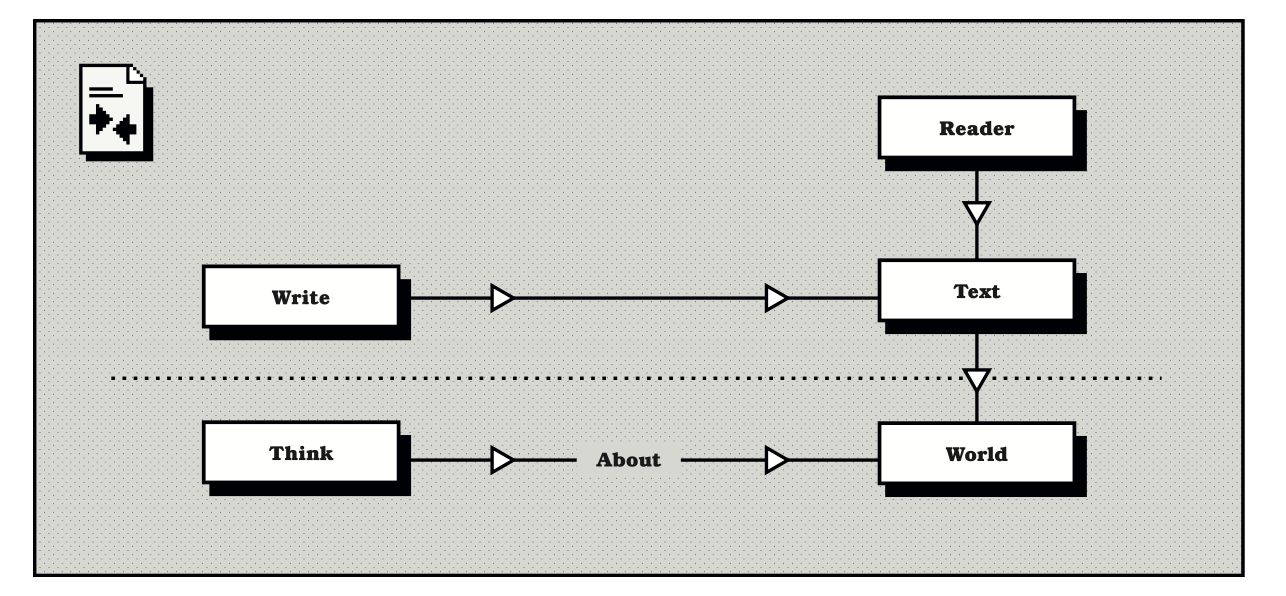
This is explained brilliantly by Larry McEnerney, Director of the University of Chicago’s Writing Program. I’ve reproduced the diagram that he draws on the blackboard in the video below.

The crux of the problem is that in order to think about the world, you have to write. In technology we work in a complex domain on problems that require a lot of thinking, so the process of initially creating a proposal or a design document is to enable that thinking process to happen.

We rarely have everything figured out in our head before we write it down: instead, we have to write in order to uncover all of the details. This is because the act of writing forces us to explore the problem space. The issue here is that the text that you produce in order to think about the world and come up with a solution to the problem is rarely the best text to portray your view to the reader. Therein lies the problem.

You still need to write in order to derive a solution, or to form an argument. But it needs additional work and rework in order to make it something that’s best for your audience. Without your audience using your writing to further their own thought, you simply haven’t written for anyone but yourself.

Bug #2: An inability to imagine yourself as the reader

This leads into the second bug in bad writing, which is when a writer is unable to imagine themselves as the reader of their work. This involves mentally stepping back, being able to read something with fresh eyes and zero context, and seeing whether what was written actually portrays the writer’s intended worldview. 

If it doesn’t, then it requires further editing to make sure that it becomes apparent on the first pass. It needs to be pitched with the right level of knowledge so that it makes sense effortlessly to the reader: you have to know your audience.

When you read emails, messages or documents that really don’t make much sense, or are written incredibly badly, do you reckon that the writer has truly read it back in order to make sure that it represents the best possible version of their idea or of themselves? Did they really have you in mind?

Probably not. The impedance mismatch between the true impact of what the writer has written and what they think it reads like in their head—where all of the context already exists—is the gap that needs filling by reworking in order to make it better.

Experienced writers are able to immediately switch their brain into “reader mode” at any given point in the writing process and then offer themselves critique, then switch back into “writer mode” and implement the changes. You have to act as your own editor, and being able to train the muscle of self-editing comes through exposure to writing that is far better than your own, so you can feed its characteristics into that self-critique model during future use.

It’s worth mentioning that in a work context, “better” writing often means “clearer and easier” rather than “impressive”. You are not being read as a novelist or poet in your work, so leave the grammatical trick-shots for your spare time. Again, know your audience. The reader of your text needs to immediately understand what you mean and what you want them to do as a result.

Bug #3: A lack of clear actions and next steps

Which moves us neatly on to our next point. If writing at work is to spread your ideas and to allow you to exert your influence, then you need to remember that those that you wish to influence the most are often those with the least time. 

You need to write in such a way that captures their attention, makes it explicit what you want them to do (read, comment, decide, or ignore), then make it as easy as possible for them to do it.

A good tip is to prefix any long form text that takes more than a minute to read with a bullet point summary of the main points and the required actions. I receive a lot of update emails at work of which I don’t always have the time to read in detail, but the summaries of the key points mean that I can safely choose to move on if I am time-pressed.

Saving your readers time by being explicit in what you want is one of the biggest gifts that you can give. We’ve all read books that could have just been a blog post, and we’ve all read long documents that seemingly go nowhere or are unfinished. This causes friction for the reader and it reduces the trust between them and the writer for future interactions.

If you’re looking for a decision, be explicit. If you’re sharing your thoughts in case they’re interested, then say so, since if they are not they can choose to skip. If there are clear actions that need to be taken as a result of what you’ve written, make sure that it is impossible to miss them. 

Again, this requires iteratively switching into “reader mode” and giving yourself that self-critique. It’s a muscle that needs to be trained.

Bug #4: Just not enough time in the gym

You can’t expect to become a good writer overnight. It takes lots of practice, often in secret, often producing hot garbage that may never see the light of day. I’ve probably deleted far more sentences than I’ve published over my lifetime.

As I said earlier, the best way to become better at writing is to write. I missed a critical word from that sentence, however: improvement comes through writing intentionally.

The good news is that there are countless opportunities to be intentional. Every email, every document, every chat message, every SMS, and every note to yourself during your working day is a chance to sharpen the sword.

These opportunities aren’t particularly glamorous and they will often be unseen. This is why I opened this piece of writing by discussing motivation: if you truly want to get better at writing then all of the opportunities that you need to do so are right there underneath your nose. But they won’t make you a famous writer. That may or may not come in the future as a side effect of the level you reach in your craft.

So, there’s no prescription, just practice. And by the time you’re good at it, you won’t even care whether you’re good any more. You’ll just write, because you have to.