So what do you do?
There is a house for sale two doors down from where we live.
At the weekend, I was working outside of our garage, filling the car with scrap wood from an internal wall that we had demolished.
A man, who I would place somewhere in his forties, left his parked car and approached me. He had seen the listing online and had come for an initial drive by. After telling him what I knew about the area, such as the levels of quiet and the schools, he asked me a question:
“So, what do you do?”
It’s such a simple question. But it’s loaded with many implicit sub-questions in the context of somebody thinking of buying a house and becoming my neighbor:
- What kind of status do I have?
- What kind of money might I be earning, as a signifier for the greater socioeconomic status of the area?
- Am I doing something that is respectable, insofar that it might reflect on the kind of neighbor that I am going to be?
- Am I going to be making noise during the night, or am I likely to be asleep like most people who work standard office hours?
I’m sure that he didn’t intend to make me dwell on the motivation of asking this question so deeply. Yet, the fact is that our work identity means a lot in society.
But what actually is a work identity? How is it formed? Can it ever be problematic?
Work identity
Have you ever met somebody new and have had that same question asked of you? What kind of reaction did you get in reply? Did you impress, or was it an “oh”?
Have you ever paused to think why it even matters what you do for a job, given that you may be meeting someone in a social context, rather than work context?
Whether we like it or not, work defines a significant portion of our identity. We may be an engineer first, a father second, then a cyclist, then a brother in our own internal hierarchy. A work identity can even become a person’s entire identity: consider entrepreneurial culture, and the perception that successful entrepreneurship implies an entire way of life.
Work identities, and how we relate to them consciously and subconsciously, can cause conflict within us. We should aim to become more aware of them and how we can try to work with some of the problems that they bring.
But who am I?
How work identities exist in tension or conflict with oneself and with other people can be challenging. The field of work identity is broad and fairly academic, but from my own experience as a manager and leader (cough, I hate describing myself as that), I often see people struggling with some common issues:
- The work identity shift from being an individual contributor (IC) to a manager.
- Balancing work identity with non-work identities, such as being a parent, or carer, or friend.
- Mixing authoritative work identities with flat company cultures. Am I someone’s friend or colleague?
- Dealing with role engulfment which is where one’s work identity becomes their primary identity, and the life conflict that entails.
Let’s have a look at these in turn.
The shift from IC to manager
“Oh, so now you’re their boss?”
This is the primary work identity conflict that I see, especially in new managers. Making the transition from IC to manager involves the undertaking of an entirely different role and identity.
- They are now responsible for some number of staff and their performance as well as their own.
- They are also likely responsible for some conceptual area, such as an engineering team or some part of a software application architecture.
- They now have a new set of peers, subordinates (cough, I hate that word) and more senior staff that they report to.
Their status in the organization has changed, and hence their work identity needs to reform.
There are many questions. How should they act towards their manager, their peers, and their own staff? Should that be the same or different? Are they now managing people that were previously their peers, or even their friends? How is that going to form how they think about themselves and how others think about them?
Some people can naturally flow between being friendly, authoritative, relaxed, directive and back again. However, this is a learned skill.
Some new managers fail to embody their new managerial work identity and thus fail to establish any authority, making them ineffective. Some will embody a caricature of a manager – with no true conviction – which can be laughable and Alan Partridge-esque.
I’ve found that there are two good places to start when learning the ropes as a manager:
- Going through a contracting exercise to more formally establish relationships between their staff and with their own manager.
- Reading and practicing the principle of Radical Candor, which is the closest thing I’ve found to embodying the right level of candidness and empathy required to operate well as a manager in challenging organizations.
Merely doing exercises and reading around embodying a managerial identity isn’t enough: being able to turn up and down different facets of your personality at given times, and thus form a strong work identity that you are comfortable with, takes real repeated practice.
New managers may need to resist the urge to shy away from social activities, like sitting down to lunch with their team, or consciously practice giving uncomfortable feedback even if it initially feels unnatural and scary. With time, switching between identities becomes easier. But it’s never easy.
Balancing work identity with other identities
There is a tension between your work identity and other identities in your life. A person may be the CEO of a company during the day, but a mother and partner during the evenings and weekends. These different identities don’t always get along with each other.
Although there is an argument that achieving work-life balance can be impossible due to the demands of modern careers, the scheduling of time as a CEO and a parent and a mother is straightforward: the main tension comes from having to intermix work identities with personal identities.
The parent identity that is singing along with Pepper Pig, only to get interrupted by a work call, must then switch to the work identity of the CEO, if only for a brief moment, and then back again. Becoming expert at this comes with practice. Initially, it can take a lot of time to switch into and out of one’s work identity, and can cause stress and conflict between the self and others.
I used to struggle with switching identities most when the apartment that I lived in was less than 5 minutes walking distance from the office. After particularly intense work days, my partner would notice how I “wasn’t myself” for a period of time after work, or that my interactions with her were different (typically colder and more robotic) to how I acted at the weekend.
With time I came to learn that it would take me a while to switch away from my work identity – which was that of a new manager in a fast growing startup – into my identity as a partner and peer.
If you struggle with this, there are some strategies that I found helped me:
- Consciously deciding to leave my work identity at the office, or at the computer, and telling myself to switch back into my home identity. This may sound contrived, but it worked. “OK, I’m done. Time to start my evening.”
- Putting some physical activity between the end of the work day and the beginning of the evening. This could be cycling or walking a longer route home from work, or it could mean going to the gym. The physical exertion and subsequent release of endorphins resets the mind.
- Taking some quiet time when I got home. Just five minutes of meditation helps greatly.
Mixing authoritative work identities with flat company cultures
A common source of tension is the contrast between a company’s desire to have an open, friendly culture that feels like a flat hierarchy and the conflicting authoritative work identities that exist within it.
Does a culture of everyone being equal cause issues when the boundaries between traditional friendship and org chart status blur? Our company has a friendly culture, encouraging everyone in all parts of the organization to take part in social activities, and many close social groups exist both inside and outside of work.
However, the more senior one becomes in an organization, the more carefully one must shift between different identities in their persona. Embodying a friend identity whilst out for drinks with one’s team may need rapid shifts to the manager identity when talking about a sensitive work-related subject, and then back again to being a friend when switching to a conversation with another colleague.
The difficulty of constantly shifting these identities can sometimes explain why senior people in an organization find work-related social events hard: they have to be able to embody the right identity at the right time in order to uphold their professional position, but also be able to have fun. It can be exhausting, and I’m sure we’ve all dealt with that colleague who’s had a little too much to drink.
Additionally, those in management positions who are not able to shift between identities with ease can find it hard to get on in flat company cultures. Either they are unable to shake the manager identity and thus feel excluded from the fun, or they are unable to turn on the manager identity when it is needed, lessening their authority and having people question their competence in their role.
It really isn’t easy.
Preventing role engulfment
We have spent most of the article thinking about the difficulties of switching between work and other identities. But what happens when, over time, someone’s entire identity is defined by their work?
There is a term for this: role engulfment. It is used to describe when one role – or identity – grows to become the dominant aspect from which one views themselves. This can happen in any context, not just work. For example, people may attach a negative role to themselves which they begin to define themselves with, such as being ill, or badly behaved, or unable to learn.
In a work context, role engulfment describes the situation where someone begins to identify themselves as wholly the role they perform. We mentioned the entrepreneurial identity earlier on in the article, and how it can engulf one’s lifestyle.
Someone may view themselves primarily as a CTO, or CEO, or a senior engineer. Given how work-centric the younger generation of our workforce has become, this may be happening more than ever.
It is, however, dangerous:
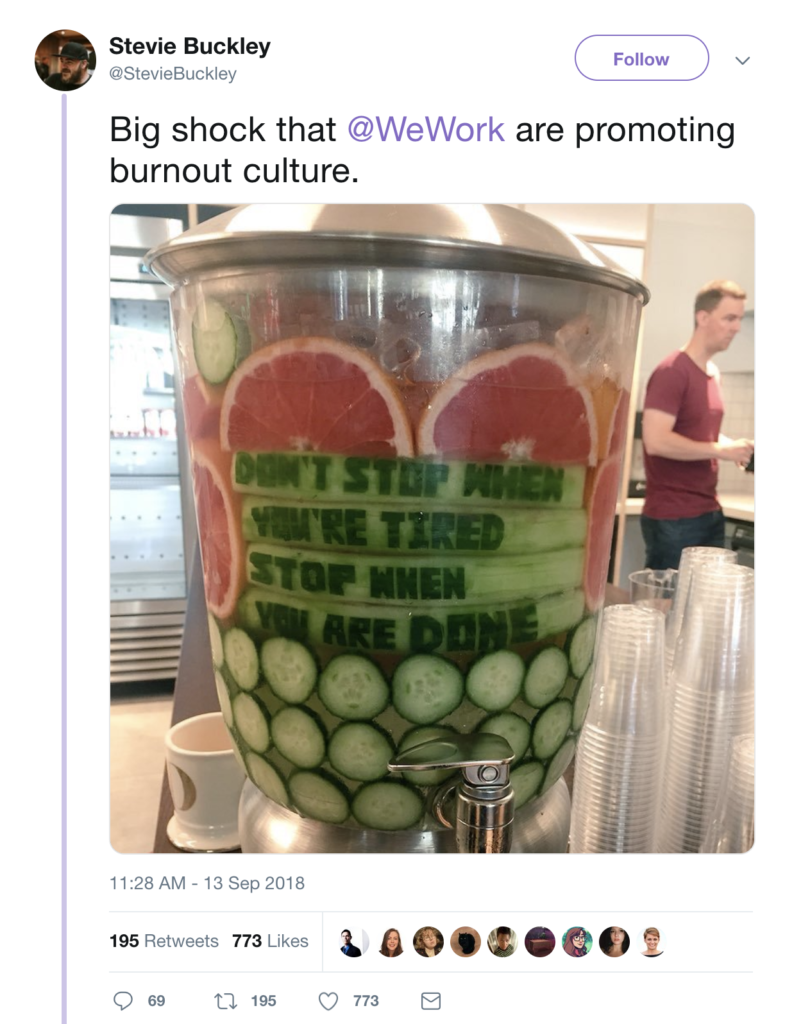
- Choices that one makes for themselves are influenced primarily by the work identity. They may not be choices that are in the best interest to the whole person. Take burnout for example: working to the point of illness in order to achieve a promotion may satiate the hunger of the work identity, but it certainly does not help the whole individual.
- It lessens the amount of effort that a person spends on their other identities, such as a father, mother, sibling, friend or carer. The work identity begins to trump the others because the reward is seen as more fulfilling and more aligned with the true self, whilst other aspects of a person’s life suffer. Maybe visiting family isn’t as important as embodying the successful executive director and working through the weekend instead.
- When an individual forms their predominant identity around their work, then what happens if their work is to suddenly go away? Redundancies can strip a person of their identity and not just their income. These situations can be dangerous for a person’s mental health. Many retirees suffer greatly with their work identity removed from their life.
So, what can I do?
The concept of work identities, and the other identities that they coexist with, are – in my opinion – not talked about enough in our industry. However, I think that understanding them more and being more conscious about how we live with them can benefit us all.
In a world where one’s job is the implied answer to “what do you do?” we need to understand that work is only one part of our whole identity. Humans are so much more than our jobs.
I am also a partner, friend and son as well as the VP Engineering role that my colleagues know me as. Although the job title sounds lofty and important, and one could suggest that it should become more of me, the other identities that I embody are just as important – if not more important – to ensure that I am living a balanced and well-rounded life.
Which identity do you associate yourself with most?